

Hemp Seed - Through a Dietitian’s Eyes
Oilseeds are excellent sources of micro- and macronutrients. That’s why we love them—not just for their taste.
However, it would be difficult to highlight a single vitamin or mineral. Not only because there isn’t one element that stands out numerically, but also because if we emphasize, for example, that hemp seeds are an excellent source of magnesium, it might suggest that they are better than others. Yet, the key to healthy eating, supporting health, disease prevention, and sustainability is to eat as varied a diet as possible, incorporating several small meals.
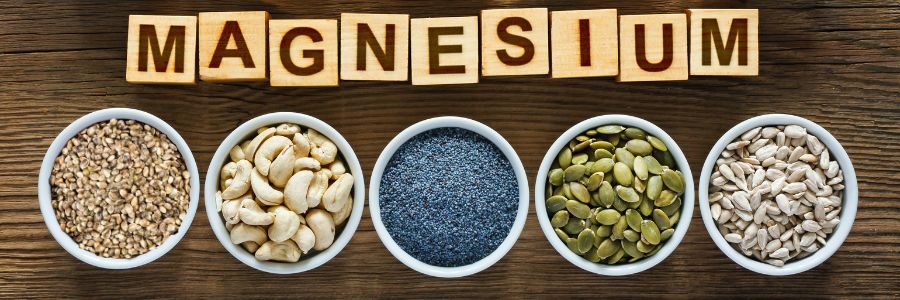
That said, it is true that hemp seeds are an outstanding source of magnesium (700 mg/100 g, which is 200% of the daily requirement), but in some nutrients pumpkin seeds excel, in others poppy seeds perform better, and so on.
And of course, it also matters which one we prefer and why. There’s no need to force hemp seeds into your porridge, hemp seed oil into your salad dressing, or hemp seed cream onto your dinner sandwich, but it’s definitely worth trying one of them, because hemp seeds are indeed part of conscious nutrition.
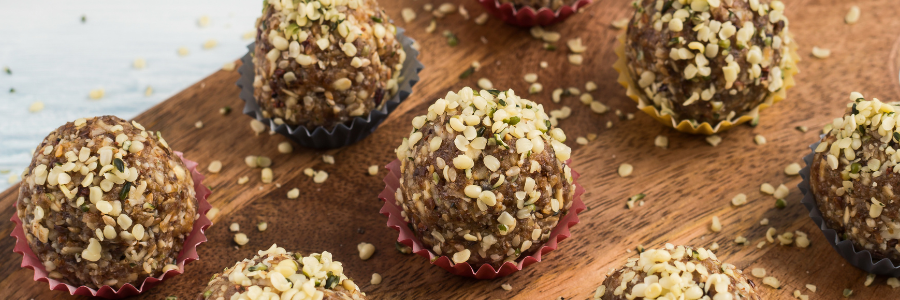
After the holistic seed overview, we can now focus on hemp seeds.
MACRONUTRIENTS
Carbohydrates
Hulled hemp seeds become truly enjoyable, but their fiber content significantly decreases—from 30% to only 3-4 g/100 g. Along with this, their carbohydrate content also approaches zero (2–2.5 g/100 g). This carbohydrate amount is also reflected in hemp seed cream. How should we view this? No, carbohydrates do not inherently cause weight gain; 1 gram of carbohydrate has the same energy content as 1 gram of protein. Hemp seeds can be an excellent food for those with sugar metabolism issues who cannot skip carbohydrate counting. With this amount, you don’t really need to count it, and moreover, the high protein and fatty acid content of hemp seeds and hemp seed butter helps slow the absorption of carbohydrates from foods consumed with them—for example, porridge or bread with hemp seed cream.
Protein
Hemp seeds (~30 g/100 g) and hemp seed cream (~20-22 g/100 g) both have very high protein content. Just think, chicken breast has about ~22 g/100 g protein, and although we consume them in different amounts, the similarity is striking. Less scientifically valid, clickbait sites often praise hemp seeds excessively, but to remain professionally accurate, it must be said that although hemp seeds contain all essential* amino acids that build protein, some are missing for completeness, and some are limited. It is poor in lysine (one of the essential amino acids), so it is worth consuming hemp seeds combined with lysine-rich plant protein sources, i.e., legumes: for example, as white bean pâté with hemp seed cream. However, it is good to know that within the body, this complementation can also happen offset over time; the body manages delayed complementation. So, if you have chickpea curry for lunch and hemp seed cream under zakuszka for dinner, the balance will still be perfect—it’s okay if not everything is on the same plate at once.
Fat
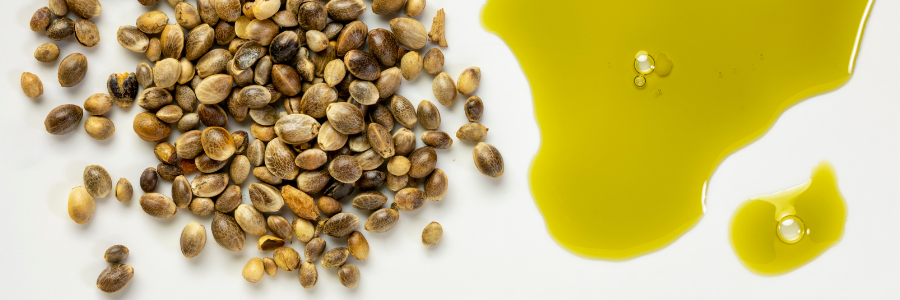
All oilseeds are rich in unsaturated fatty acids. What makes hemp seeds—and hemp seed oil—special is that the essential* fatty acids they contain are present in exactly the ratio recommended by healthy eating guidelines. The ratio of essential unsaturated fatty acids, omega-3 (alpha-linolenic acid (ALA)) and omega-6 (linoleic acid (LA)), is exactly 1:3. However, you don’t need to immediately switch to a fat-free lifestyle and consume only hemp seed oil, because this is not the only path to health. Reality is more exciting and complex, as scientific results sometimes contradict each other regarding ratios. One thing is certain: ALA intake is easily achievable (with all kinds of oilseeds and vegetable oils), and everyone should definitely focus on omega-3 intake. Primary sources for this can be walnuts and walnut oil, flaxseed oil, and a great tool is the month’s star, hemp seed oil as well!
MICRONUTRIENTS
Vitamin E
We start with this micronutrient right after fatty acids because, on one hand, vitamin E is one of the most commonly taken “women’s” vitamins in artificial form for skin beauty, and on the other hand, because this vitamin naturally acts as an antioxidant protecting the unsaturated fatty acids present in hemp seeds. This abundant vitamin E (90 mg/100 g – so just one large tablespoon already covers the daily requirement) protects the unsaturated fatty acids in hemp seeds so they can fulfill their positive functions in our body without oxidizing.
Trace Elements
Hemp seeds are also a source of numerous essential trace elements: zinc, magnesium, potassium, calcium, sulfur, iron, phosphorus. That’s why I often say that if I were a dietitian with a prescription pad, I would write for domestic oilseeds: daily 2×1 tablespoon of natural, unsalted oilseeds, enjoyed with plenty of fluid.
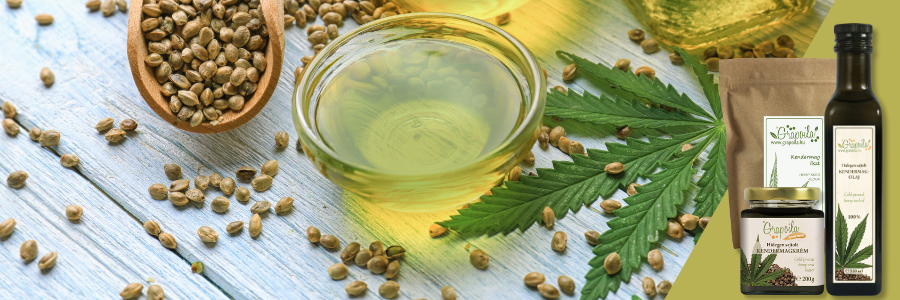
In summary, it can be said about hemp seeds (and the cold-pressed hemp seed oil or the hemp cream sold as the sediment at the bottom of the oil) that they contain such a wide variety of micronutrients (vitamins, minerals, trace elements, antioxidants, polyphenols, and other bioactive compounds) that research is increasingly focusing both on the individual active ingredients and the whole seed, as well as the products made from it.
Without aiming for completeness, here is a list of diseases in which hemp seed may play a positive role in treatment and, even more so, in prevention. This, of course, does not mean that hemp seed is a medicine. Hemp seed, its oil, and cream are foods—nothing more—so consume them with enjoyment and variety. The true power of nutrition lies in its complexity, not in isolated active ingredients. Of course, if someone is motivated to eat a varied diet for health reasons, we gladly share the health benefits, some of which have been proven in vitro (anti-inflammatory, immune-supportive, neuroprotective, blood pressure-lowering, cholesterol-regulating) and some in vivo (atopic dermatitis).
What everyone is interested in: hemp seed or not, Grapoila products have nothing to do with the psychoactive part of the plant; hemp seed is completely safe to consume in all forms.
HEMP SEED FAVORITE
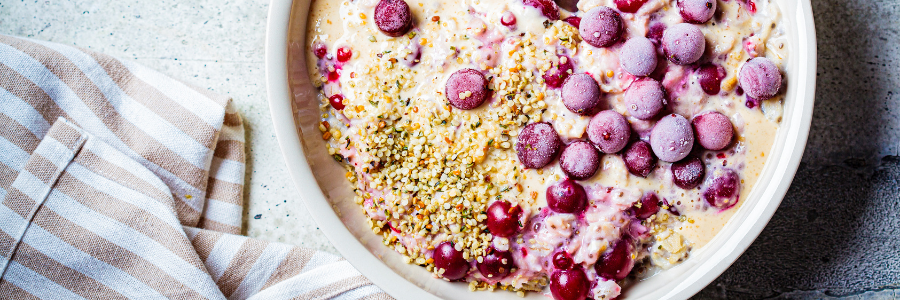
Breakfast porridge cooked in water, with natural yogurt and enhanced with hemp seed cream.
Yes, breakfast—you can have breakfast, it’s not mandatory, but I consider it a great opportunity. Well, not just me; the scientific community agrees! Even intermittent fasting (IF) performs better in scientific studies if someone skips dinner instead of breakfast, adjusting the fasting window accordingly.
And yes, in yogurt. Nutritional recommendations suggest that about half of the fats consumed in a day should be plant-based and the other half animal-based. A regular-fat yogurt (not necessarily the 10% fat, cream-enriched Greek yogurt) combined with the plant oil from hemp seed creates the perfect balance, variety, and the “holy grail” of gut flora support.
Wishing everyone a peaceful and hearty appetite!
LISTEN IN!
The HEMP SEED PODCAST is now available on our YouTube channel! English subtitles will be added soon.
